
Today I’ve posted some pictures by Ansel Adams, Dorothea Lange, and Gregory Colbert. I’ve chosen these photographers in particular because their images show a mastery over photography’s visual and/or emotive characteristics.
Ansel Adams
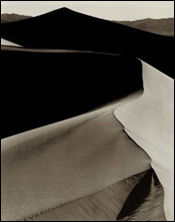
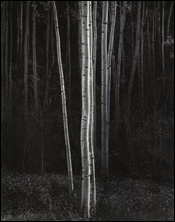
Ansel Adams is quite possibly the world’s most famous nature photographer, in part because of his exceptional skill at composition. In the pictures above, you can see how he uses fairly extreme light and dark to divide both photographs into sections.
The left picture of Death Valley is really an abstract photo, even though it’s taken from real life. Adams kept the amount of lights and darks fairly equal, and used naturally angled lines created by shadows and highlights in the photograph to pull the viewer’s eyes through the entire image.
The photo on the right works on a slightly different principle. Instead of using movement and angles, Adams uses symmetry and strong verticals. The left and right sides of the photograph are close to being mirror images, yet it’s the variation within the symmetry that keeps a viewers’ attention. The contrast between dark and light enhance the visual impact of the image as well.
Dorothea Lange
While Adams’ photos are compositionally perfect, they do lack the human spark that photography seems meant to capture. In contrast, Dorothea Lange’s images from the Great Depression are primarily emotionally captivating and only secondarily appealing for their compositions.
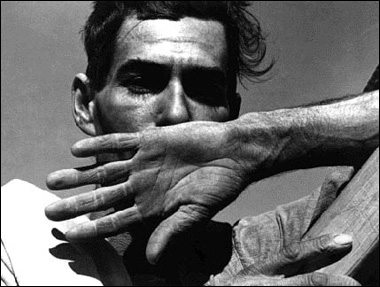
In the photo above, strong lighting is responsible for creating the sharp shadows and details in the image. Darkness fills the figure’s eyes, and his weathered and wrinkled hand covers his mouth, distancing himself from us because symbolically we can neither hear his voice nor see the emotions in his eyes.
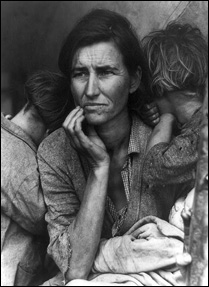 Lange’s most famous photograph, Migrant Mother, is another great example of the tangible emotion in her subjects. The children in the photo, too tired or worried to let the camera capture their pain, hide their faces as they cling to their mother’s side. Viewers can’t help but feel for themselves the worry that she’s experiencing while sitting there; without any help, without any money, and without any hope.
Gregory Colbert
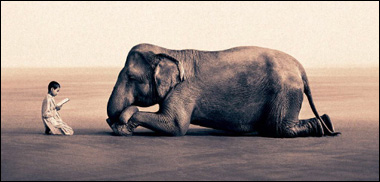
Gregory Colbert on the other hand uses photography to build both an idea and a feeling. His work, a vast collection of pictures and video called Ashes and Snow, offers imagery that is compelling for its artistry as well as its subjects.
While his subjects have none of the inherent reality of Lange’s work, Colbert’s talent is in his creation of his own truth. By isolating two figures, animal and human, he forces the viewer to confront his ideas without any distractions. His photographs use simplicity and light to indicate peaceful well-being, and by using children as models he creates a common bond of innocence between them and the animals.
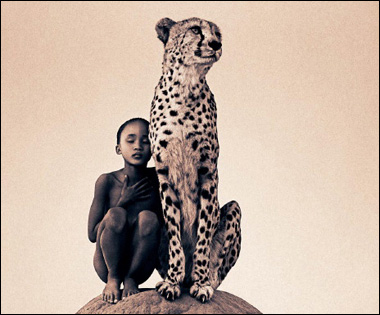
After visiting his website myself, I highly suggest you check it out. It combines video, photography, music, and narration to complete Colbert’s vision, creating an amazing experience that’s hard to leave once you’ve begun.
Both Colbert and Lange have books of photographs available at Amazon: Dorothea Lange: Photographs of a Lifetime and Colbert’s Ashes and Snow: New York Exhibition Catalogue. Also, if you’re interested in some prints or posters by Ansel Adams they can be found here.

This post may contain affiliate links.