
If the lights were to suddenly go out on a dark night, you wouldn’t be able to see a thing. Everything would be in darkness.
This makes it easy to understand darkness as the absence of light. . . but can you imagine light without any dark? That’s a little more difficult. To see anything we must have both light and dark working in concert.
Darkness has no source; it comes from every direction. Light, on the other hand, does come from a source, aiming its beams from one place to another.
Because of this, any object directly in line with those beams is illuminated on just one side while the opposing side is in shadow. And something else happens too—on the surface behind that object appears a dark silhouette known as a cast shadow.
It is this type of shadow that I want to explore in today’s tutorial.
The anatomy of a cast shadow
Cast shadows contain the following three separate pieces of information:
1. The angle of the light beams
2. The shape of the object casting the shadow
3. The topography of the surface where the shadow is cast
To illustrate this, take a look at this little sculpture, Samwise, by Howard G. Hanson.
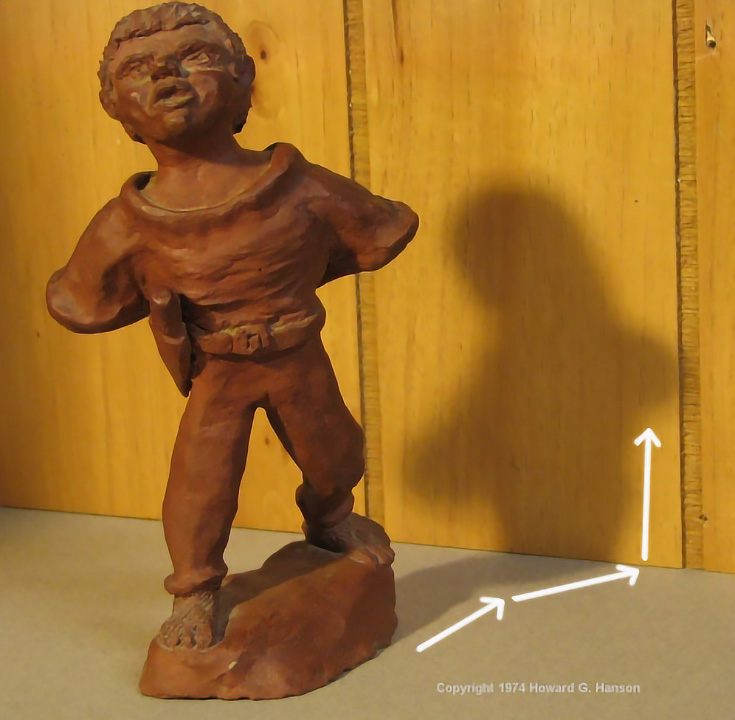
Samwise’s cast shadow puts the light beams at about a 45 degree angle, describes something of Sam’s shape, and tells us a vertical surface is immediately behind him.
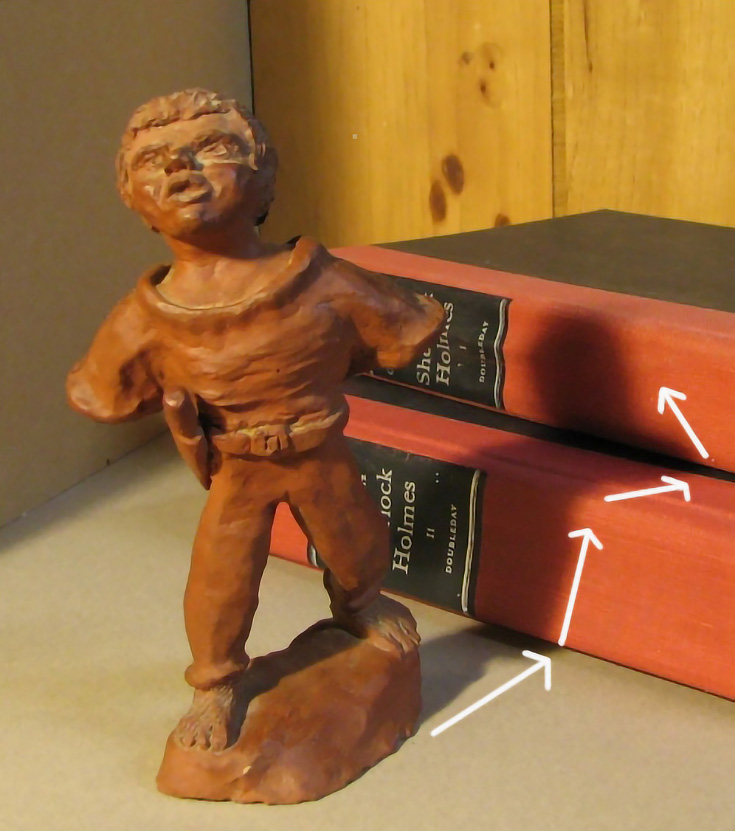
A second photo of Samwise gives the same angle and shape information as well as the topography of a stack of two books.
All this is good to know, but right now you’re probably saying, “Sure, but how can I use cast shadows to improve my paintings?”
Here are four major reasons that artists use the cast shadow as a compositional tool:
1. To anchor a subject to the page
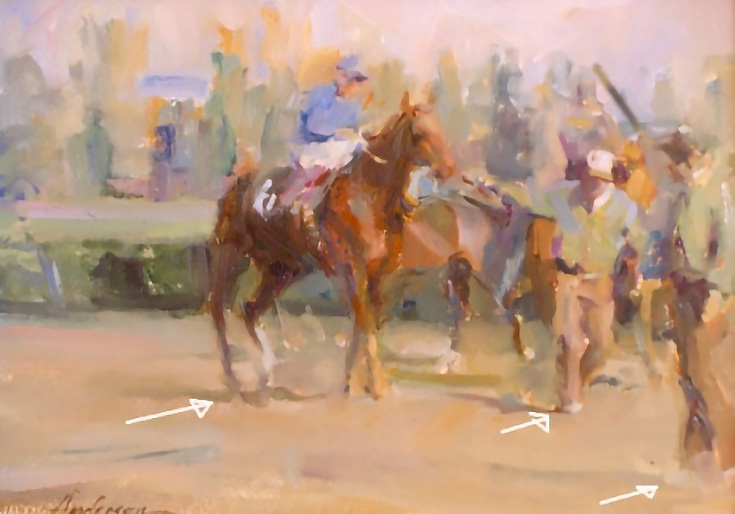
Carolyn Anderson’s high-key painting uses the cast shadows at the horse’s feet and those of the men to anchor the subject to the composition.
Imagine deleting those cast shadows—all of Carolyn’s subjects would appear to be floating, as if off the surface of the page.
2. To create a visual connection among images
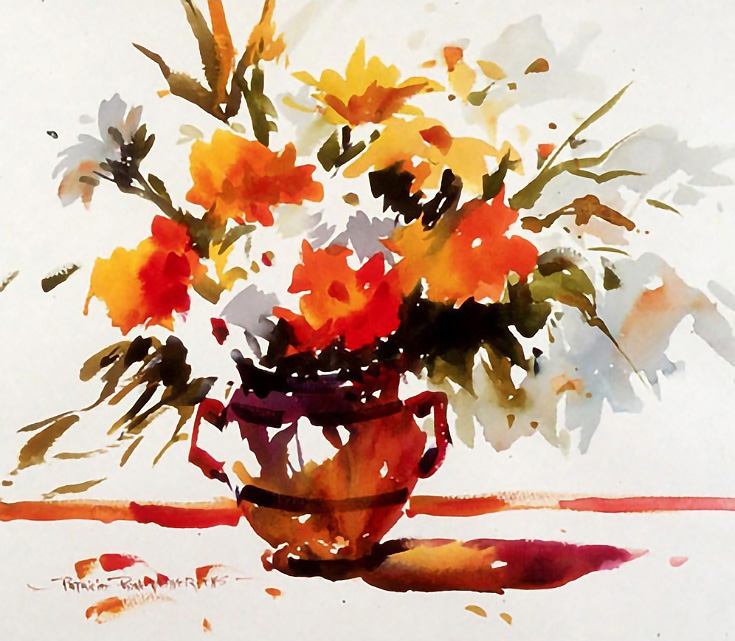
Pat Weaver’s watercolor uses cast shadows from (a) the flowers onto the foliage, (b) both flowers and foliage onto the bowl, and (c) both bowl and plants onto the surface.
These connected darks solidify and give a visual cohesiveness to her painting which is otherwise very abstract and loose.
3. To frame an area of emphasis
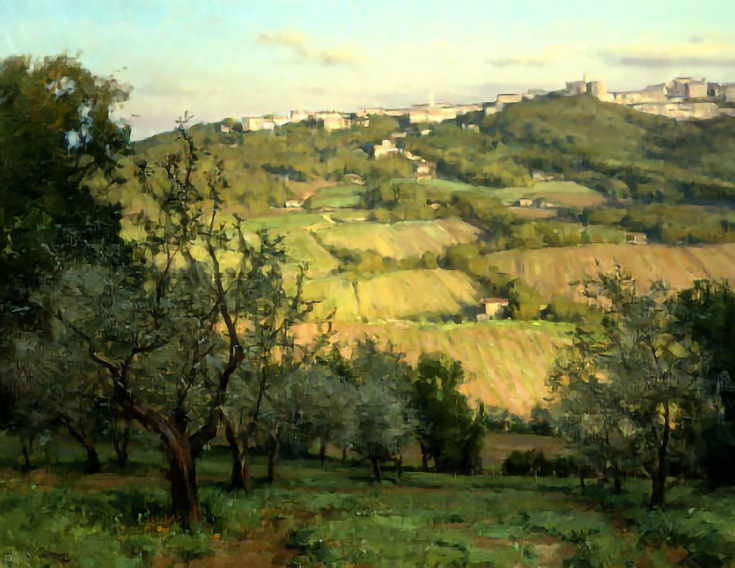
Clyde Aspevig’s “Evening Near Monte Muluano” uses a large cast shadow (created by clouds not seen in the painting) on the foreground foliage to push our attention towards the hills and village which are in the light.
This is one of the most effective and most common uses of a shadow, especially one being cast from outside of the picture.
4. To extend the main subject
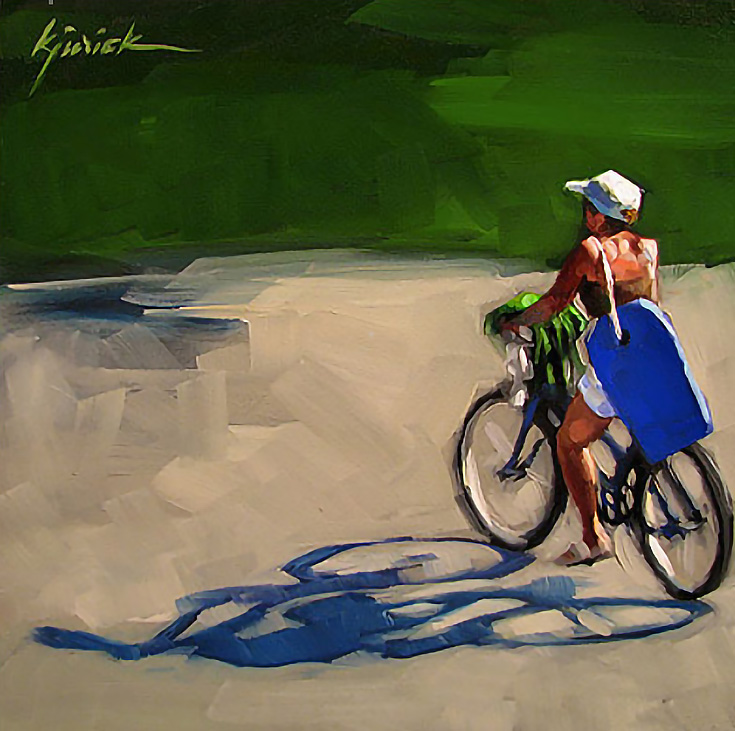
Artists often use a cast shadow to extend a subject itself, very much like Karin Jurick has done in this painting. If we were to delete the cast shadow of the bicycle and rider, half the subject would be gone.
Studying shadows for yourself
Not only can cast shadows be useful tools for the painter, they’re also nearly impossible to avoid.
One way to get ideas about how they might work in your next painting is to do drawings of just cast shadows without their objects.
Try this homework exercise: set a coffee mug about two or three inches in front of two stacked books. Position a light to cast a shadow from the mug onto the books. Do a drawing of only the cast shadow without including any of the objects.
Here’s my quick study of Samwise’s cast shadow in both poses.
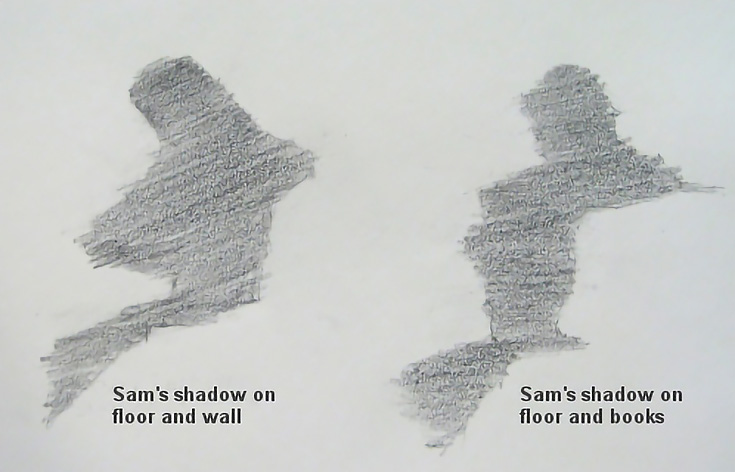
It is surprising how much you can discover about 3-dimensional space by doing studies of cast shadows without their objects.
Give this excercise a try—perhaps it will help you plan a role for cast shadows in your next composition.

This post may contain affiliate links.