
There’s something we demand of music we hear, of theatre we see, of novels we read, even of people we invite to dinner. . . we demand they not be boring.
Boredom, believe it or not, can unravel an artwork as quickly as chaos. How can we avoid it in our painting? There are a number of strategies painters use to keep their work interesting, but one of the most important ones is to vary your intervals.
What are intervals in painting?
In music an interval is the time lapse between two notes. Collected together in a pattern, those intervals create a specific rhythm.
Intervals in paintings are not much different—they’re simply the distance of a space between two or more edges. Several of these visual intervals assembled together in one painting also create a particular rhythm.
Just like in music, interesting or fun rhythms will intrigue viewers and hold their attention for a much longer period of time. For artists, the intervals that make up these intriguing rhythms are often a delight to discover and capture.
Rhythm-producing intervals appear in three specific relationships:
1. Between a shape’s edge and the outer edge of a painting
2. Between two shapes inside the painting
3. Within a single shape itself.
Let’s take a look at these intervals to see how they create more interest in a painting.
Examples of painting intervals
In this amazing little oil painting. entitled Lounge Act by Karin Jurick, we can clearly see all three types of intervals.
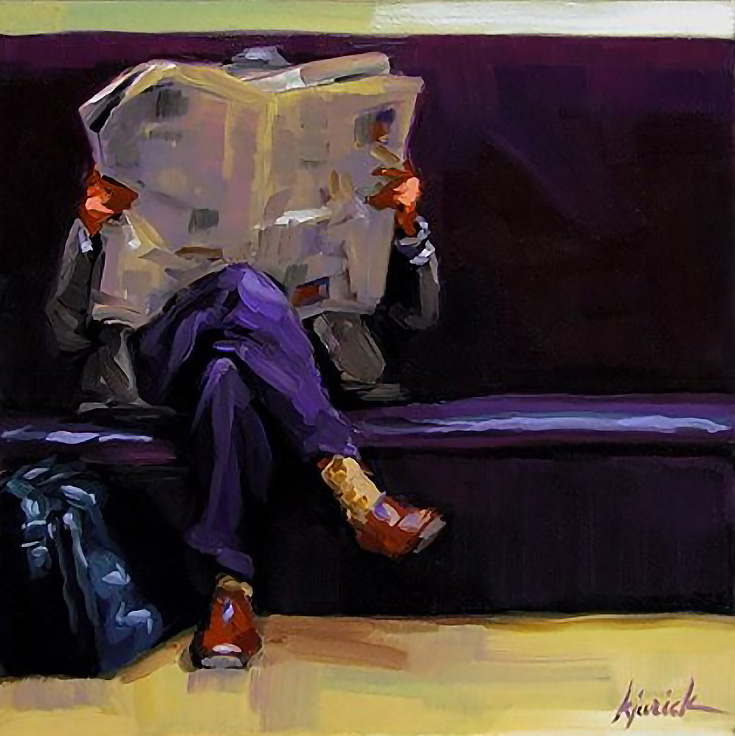
Look at the intervals between edges of the newspaper and each side of the painting. That’s the shape/edge relationship.
Then look at the distance between the newspaper and the man’s shoes—that’s the shape/shape relationship.
And finally, switch your attention to the interval from one side of the newspaper itself to the other. You’ll see an interval within the shape. Notice how Karin has varied the sizes of all of these as well as every other interval within the painting.
The end result is a painting that’s more interesting because of its intriguing rhythm.
There’s another kind of interval-producing edge that can be equally fun to work with. Look at the following examples by Pat Weaver and Albrecht Durer.
In each work there’s a continuous, fluctuating interval occuring between the edges of the subject and the edges of the painting.
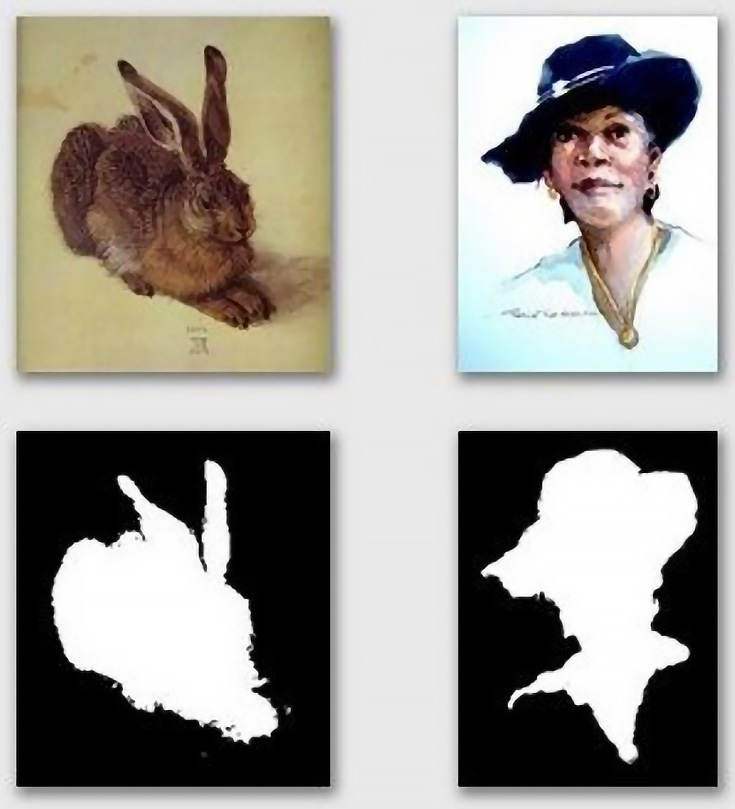
I have converted each image into a reversed silhouette to make these shape/edges relationships easier to see. Focus just on the black space in each piece, looking first at the edge of the subject, then at the nearest edge of the painting.
As your eyes move around the image, notice how that shape/edge relationship fluctuates in size—sometimes getting narrower, sometimes wider. In portrait painting (as well as in still life painting) there are special opportunities to explore intervals that make interesting variations along single line.
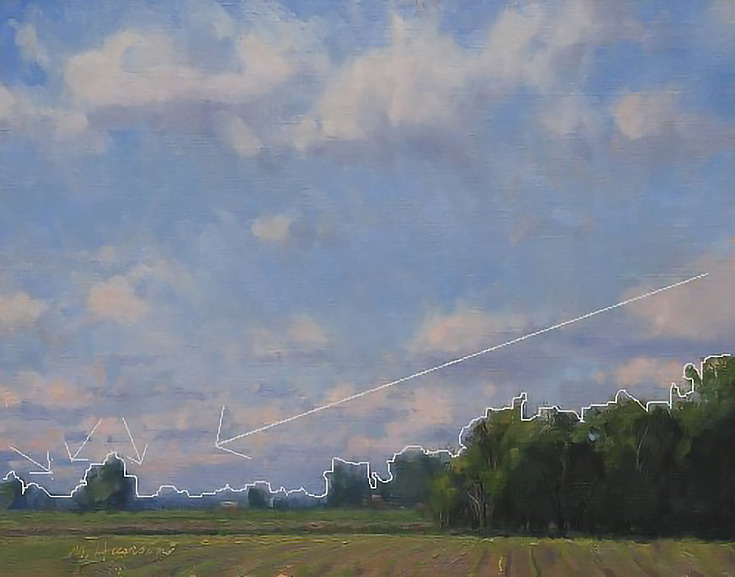
These types of intervals can be created in landscape painting as well. Look at the painting below to see how Marc Hanson did exactly that.
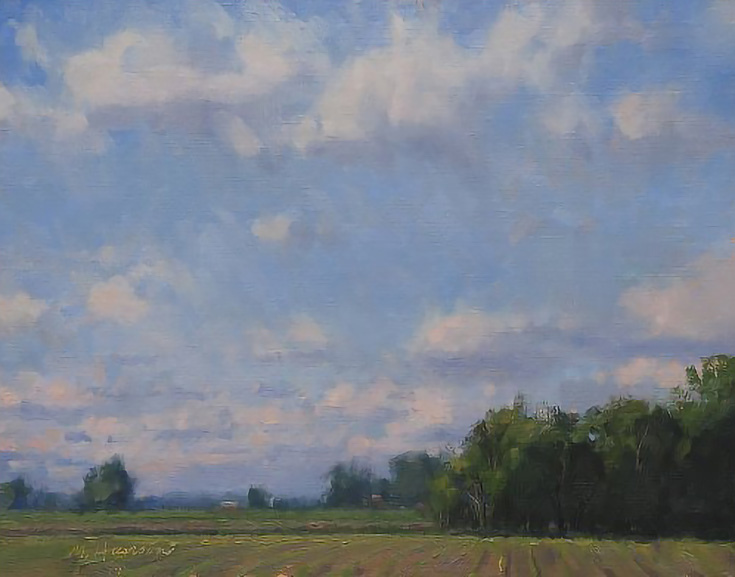
Focus on where the edge of the treetops begins on the right, and then follow that edge to the left. Notice how it fluctuates up and down along a thrust going downhill before taking a brief turn upward, then down again, before exiting the left edge.
Trees offer an astonishing assortment of intervals, depending on how the artist places trunks, limbs and foliage. Robert Genn captures an impressive display of these in his acrylic painting, Path to the Other Side.
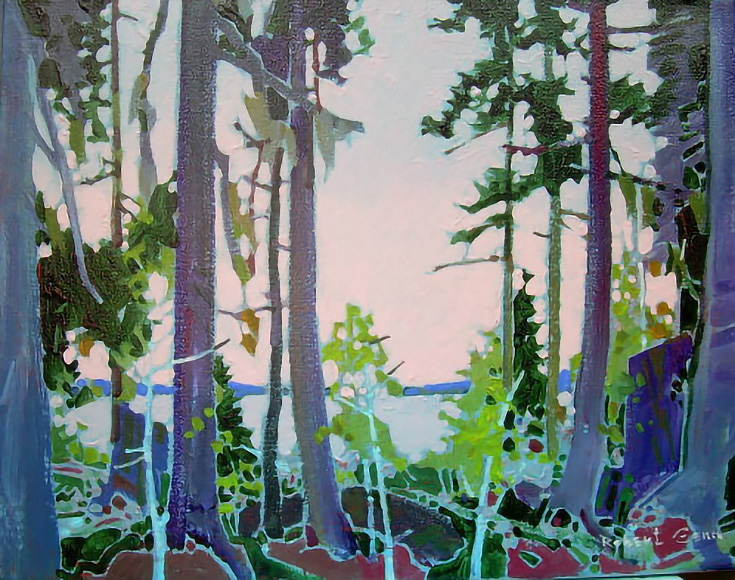
In this painting, switch your attention to the sky spaces. Scan slowly side-to-side and top to bottom, noticing just the size variations. Some are longer, some shorter, some fatter, some thinner. Then switch to the trees and foliage and do the same sort of scan. You’ll see that Genn really hits it out of the park on varying intervals in this one, creating a rhythm that could almost make you want to dance.
Explore these kinds of possibilities in your own paintings and I guarantee you’ll find your compositions becoming more unified and much stronger visually—just by the simple act of varying your intervals.

This post may contain affiliate links.