
For those of you who have your own art blog, or a personal art website (like one of our websites for artists at Foliotwist), you know how important it is that your webpages show up in Google and other search engines. After all, if you’re not searchable, it’s going to be tough for people to find you.
If you’re lucky enough to show up on the FIRST page of Google for a descriptive search term (like “seascape paintings” or “aviation artwork” for example) then you’ll probably get some decent traffic from people who are genuinely interested in your art.
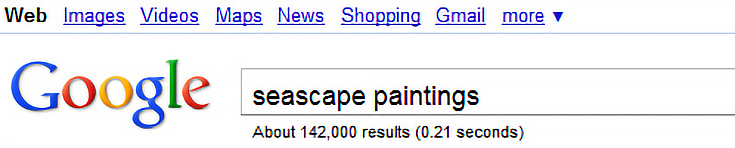
And the higher your website is on that first page, the more traffic you’ll get.
But it’s not always easy to get on the first page of Google, and it’s even tougher to move up into that coveted first position. If you’ve ever searched Google using a word or phrase that describes your artwork, then you know that already.
(If you haven’t, go to Google.com and do a quick search right now. Think of your artwork, and type in a word—or better yet, a phrase—that someone would use to search for your type of art if they didn’t know your name. Does your website show up? Hopefully it does. . . if not, go to the second page, third, and so on.)
Wherever you find your website, there will probably be others above it. And the question that artists often ask is, “Why does THAT website show up higher than MY website? My art is so much better!”
:)
Well, ignoring the quality of their art for the moment, sometimes it has to do with the words they’re using on their website. . . perhaps they’re using the exact word or phrase that you searched for in their page title, and you’re not. Or maybe those words appears in their domain name (like “SeascapePaintings.com).
But most often you’ll find that the websites directly above yours are using pretty much the same words that you are. Think about it—if you’re both artists, and you both paint seascapes, the words you use are probably going to be the same.
So if it’s not the words they’re using that help them rank higher, then what is it?
Truthfully, it all comes down to numbers. The thing that usually determines why Google places one website above another in its search results is the number of links pointing to that website.
If they have more websites linking to them than you do (or better quality websites) then they’re going to show up ahead of you in Google.
Luckily, there’s a free online tool created by Moz that you can use to check how many links YOUR website has, and how many links any other website has, too.
Even better, you can type in the sites that appear higher than you in Google’s search results and find out exactly WHICH websites are linking to them. Once you know that, maybe you can get a link from those websites too and pull ahead of them.
The tool is called Link Explorer, and it’s at https://moz.com/link-explorer.
I’d suggest starting out by typing in your own domain name just to see how many people are linking to you. You might be surprised at how few, or how many, links you actually have. It’s something that’s always good to know.
Then, do a search in Google for a word or phrase that you think YOUR site should show up for. Find a few websites that are ranked above yours, and type those websites into Link Explorer.
The highest quality links will be listed first, so you don’t have to look through their entire list of inlinks. Just check out the first few pages and see if there are any websites there that you might be able to get links from yourself.
For example, perhaps there’s a blog listed there that you could start reading and commenting on. In time, the blogger might link to your website as well. Or maybe you’ll find some directories of artist websites that you should submit your site to.
Make a list of all the possibilities, and then start working your way through them one by one. See what happens. . . it may only take a few extra links pointing at your website to pull ahead of the people who are above you right now.
In fact—these links could be the difference between second page and first page in Google. Or tenth page and first page. Either way, it’s definitely worth trying.
Good luck, and happy link-hunting! :)

This post may contain affiliate links.