
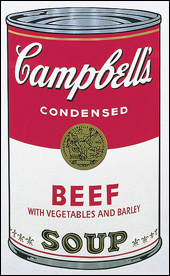
 You might know Andy Warhol simply as a painter of Campbell’s Soup cans or the artist who made colorful Marilyn Monroe prints.
Looking back, his art probably feels more retro than revolutionary—after all, we’re used to seeing “art” every day which is much weirder than these familiar pop art images.
But Andy Warhol wasn’t just another pop art artist; he’s actually one of the reasons that art is so diverse today.
Born in the 1920’s, Andy Warhol grew up somewhat isolated from other children due to some persistent health problems. He spent a lot of time drawing, studied art in college, and eventually entered the world of commercial illustration in New York.
He was good at it too, creating magazine ads with a particular inky style that was very popular for a time.
Getting his art into the galleries, however, wasn’t so easy. Back then there was a clear line between fine art and commercial art, and Warhol had become a well-known commercial illustrator.
But Andy Warhol decided to use that to his advantage. He began to experiment with the stuff of commercialism itself—logos, trademarks, icons—things that had no “fine art” qualities at all.
His break out paintings were the (now famous) series of Campbell’s Soup cans. They immediately became popular with the public and catapulted Warhol’s career.
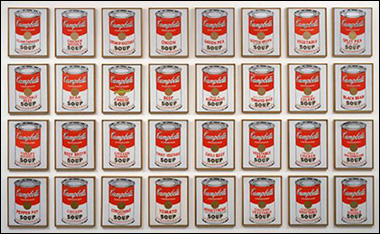
After painting the soup cans, he switched almost completely to silkscreen printing (because it was faster) and stopped personally making his artwork all together. Instead, he had assistants and other artists create his silkscreen prints at his New York studio, which became known as The Factory.
In time his art was totally mass-produced, closely mimicking the mass-produced products he often depicted in his work.
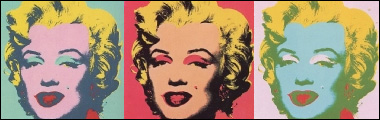
Warhol also helped prove that all you need to be successful in art is a gimmick. Just using ordinary household items as subjects in his art initially launched his career; later on his silkscreens were known for their use of vibrant color and celebrity depictions, like the Marilyn Monroe prints below.
Being a little different didn’t hurt him either, and Warhol actually became something of a celebrity himself. He was reserved and quiet in public, showing a kind of “blank” face to the world while constantly turning out bizarre artwork that was both immediately recognizable and odd at the same time.
When asked what his art meant, Andy didn’t like to explain, adding to the mystery. But anyone who asked had already missed the point—his art didn’t mean anything.
However, when his art still sold, without having meaning, it showed the world that fine art, commercial art, and even marketing were not so very different after all.
In the 70’s and 80’s (until his death in ’87) he seems to have done more marketing than art as he “sponsored” musicians, started a magazine, wrote books, and appeared on TV.
And if you could somehow ask him, I think Andy Warhol would probably say that all of it, EVERYTHING he did, was art.

This post may contain affiliate links.