
Peter Paul Rubens was arguably one of the best painters of the 17th century Baroque style, and certainly the most famous Northern European painter of his day.
His self-portrait here shows a restrained nobleman, dress sword included, and was painted late in his life after a very successful career in art, politics, and business.
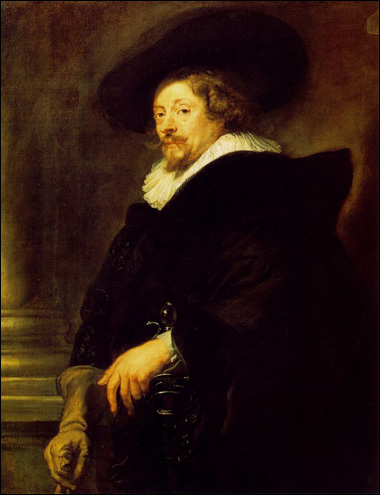
A Flemish artist, Peter Paul Rubens was born Germany but raised in Antwerp. Right at the turn of the century Rubens traveled to Rome, watching and learning from the great masters of Italy while soaking in the soaring frescoes of the Roman Cathedrals.
It was in Rome that he learned to compose huge paintings which made use of all the grandiose movement and emotion that embodies Baroque artwork.
Taking that knowledge with him back to Antwerp, Rubens soon “cornered the market” in the North, creating massive works by the dozens in his artist’s workshop. With many apprentices and painters working under him, Rubens could simply sketch the initial compositions of his paintings, letting others block in most of the painting, and then finish off the artwork by completing the details—usually just the faces and hands.
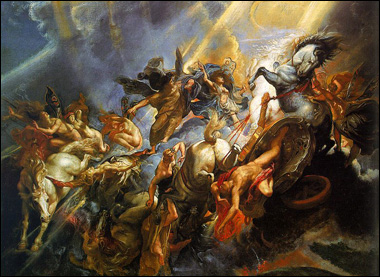
The Fall of Phaeton above is one example of Ruben’s masterful composition on a large scale. The mass of bodies form a diagonal oval in the center of the painting, separating dark and light sides of the canvas. Each figure is caught mid-movement, their bodies arranged to help the viewer’s travel continually around that oval.
In this next painting, St. George and the Dragon, Rubens provides another roiling, drama-filled scene.
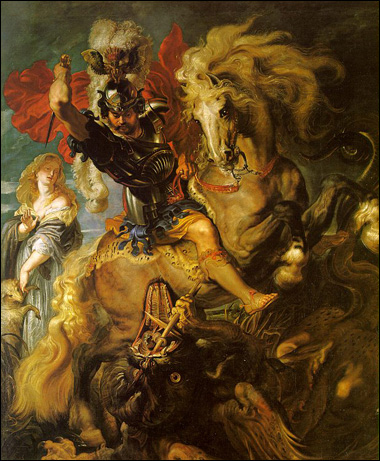
The influences from his time in Italy are obvious, yet there’s also a clear Northern twist. Like much of the Italian artwork he was exposed to, the woman in St. George and the Dragon is very classically painted.
The detail in the the armor and cloth, however, or the crest and plume of St. George’s helm—all of that simply showcases an eye for detail that made the artwork of Northern Europe so different from the South.
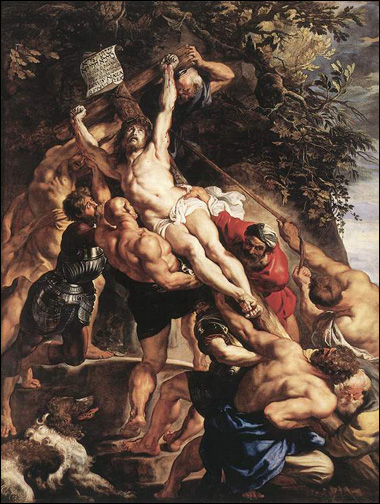
But Rubens greatest works were probably his religious paintings. Raising of the Cross, shows a fantastic use of light playing across the figures (no doubt learned from Caravaggio) and a powerful angled composition giving dynamic tension to the scene.
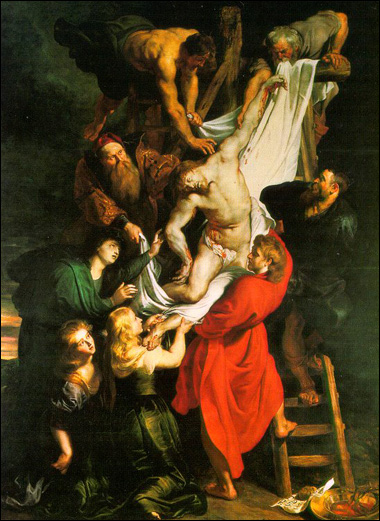
In contrast to the above painting, The Deposition has very little strain or intensity. It is the aftermath of the crucifixion, after all, and Rubens was a master at using movement in his paintings to express exactly what the situation called for.
Peter Paul Rubens was extremely successful, and transitioned from “just” being an artist into a celebrity of sorts. He received knighthood in England, discussed science and archeology with the greatest minds of Europe, and was trusted with delivering important messages between the rulers of Spain and England.
Widely respected, Rubens died at the age of sixty-three, an artist, scholar, and gentleman.

This post may contain affiliate links.