
 Cathy Horner has been designing vintage collages since 2007, when she happened upon Somerset Studios magazine and realized she could combine her love of vintage materials with her love of creating.
Shortly after putting her work online, Cathy was contacted by a local gallery to host her first show. In the following months she learned everything she could about framing, print making, artist statements, and creating art that sells. By the show’s end, she’d sold nearly half her work.
Like the classic fairy tales of old, Cathy’s career is a beautiful story to tell. But it hasn’t always been easy—she credits her success to her willingness to learn the business, to being open-minded enough to remain a student of the arts, and to continually practicing the skills needed to create stunning pieces of collage art.
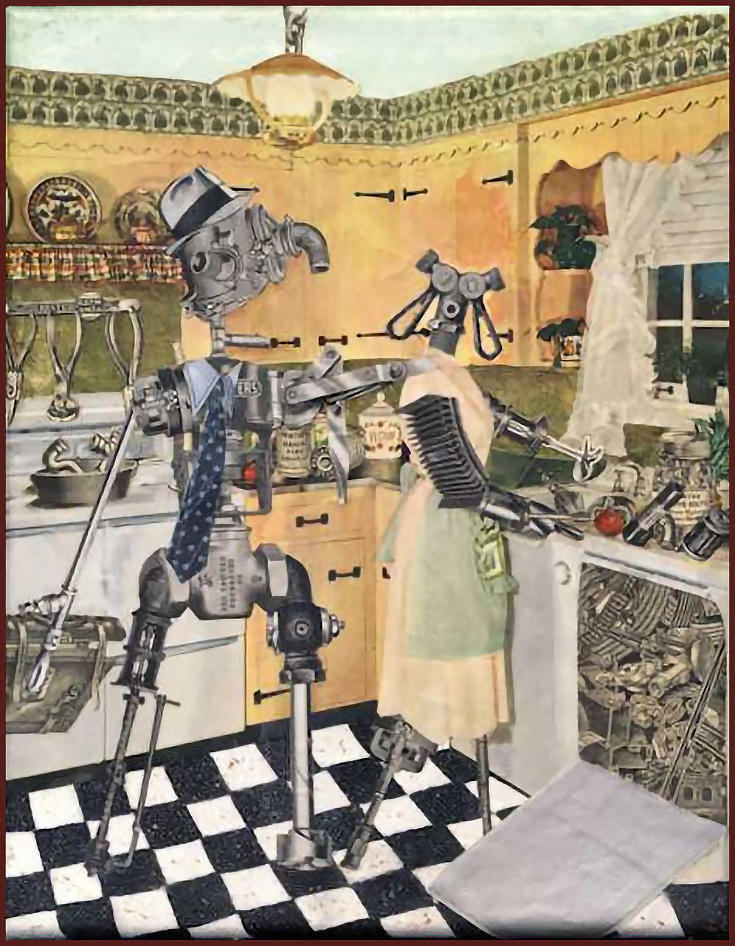
Alyice: Your collage art has often been referred to as “fine art” which differs from craft-style art projects. What makes a collage a work of “fine art” versus a “craft project
Cathy: This is a difficult question to answer. To me, a craft project is like a kit with ready-made materials for the project. Whereas art, whether it’s labeled fine art, folk art, or just art, is about creativity, originality, and the passion put into the work. It is about using the imagination and putting the necessary time into finishing it.
Alyice: A lot of your collage art is dimensional. How does one create dimension with scraps and cuts of papers?
Cathy: I have to really brainstorm to get the dimensional effects. I’ve had no formal training in art, but I know there have to be focal points.
I create focal points by hand painting shadows in order to create depth. I think through the color palette to get an idea of what the overall result will be. I use handmade textured papers and sometimes “paint” with these papers (some scraps as small as a nail head).
I also study what other artists do. Whether it’s a painting or illustration, I study the artist’s work to get a better understanding of how to make art two-dimensional, and then use my materials to achieve similar results.
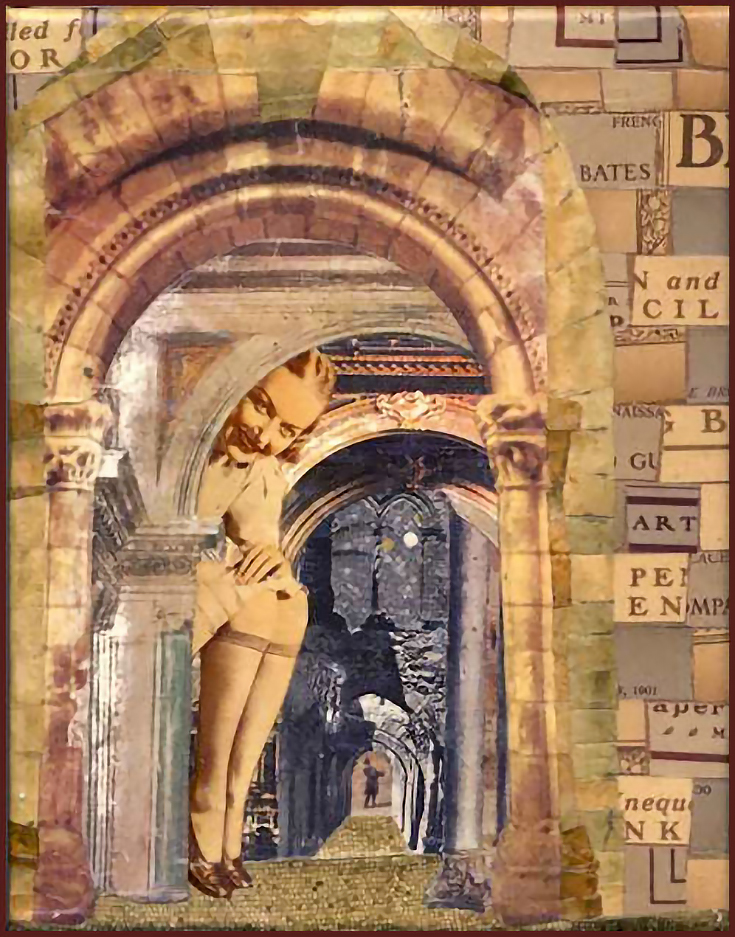
Alyice: The images in your collage art are seamless—blending together pieces of paper as though they were one sheet. How does one blend so many pieces together without creating bulk?
Cathy: I cut very carefully using small curved decoupage-type scissors that slightly feather the edge. Collage art takes a lot of advance planning. All the pieces must be arranged then taken apart in exact order, then layered back on to the canvas. Some pieces are glued prior to being put on the canvas and sometimes they are cut so that the piece can go over and under another piece.
Because I use so many different types of paper, it is often my intention to create textures which are more obvious in the originals than the prints. However I do strive to blend elements together so it is difficult to see what the original image once was.
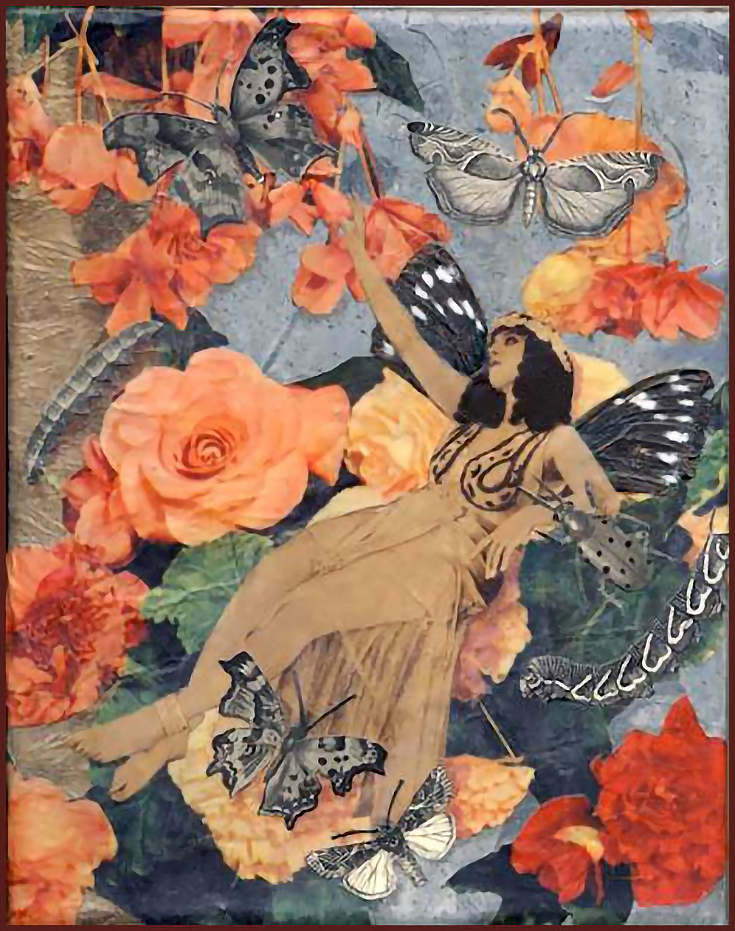
Alyice: In your artist’s statement, you write, “By the time I find them, the paper is yellowed and faded, mice have chewed the corners, and insects and moths have made their holes.” How do you clean up the images in order to use them in your collage?
Cathy: I like old paper and think it adds character, so I might just leave the paper alone. Sometimes, however, I’ll patch the paper with another old paper image, or hand painted paper, or touch it up with paint.
There are times when I have to build an item I want in the collage. In Little Miss Muffet I needed a tuffet which I made using tiny bits of different pieces from catalog images of a mattress corner, the lace off a dress, and so on.
If I don’t clean up an image, I’ll carefully seal it into the collage using a gel medium and decoupage sealer. I do this because some papers are very fragile.
Alyice: Your collage art uses vintage images as well as pages from magazines, newspapers, and catalogs. Before you go, can you tell our readers how you get around infringing on someone else’s copyright?
Cathy: My general rule is not to use images later than the 1940s. Sometimes I’ll use images from the 1950s but doing so means I must make a conscience effort to change everything enough so it would be difficult to notice.
Most of the images I use are from the 1930s or older so the copyright issue is void. If I’m in doubt I just use something else. Old images are wonderful and beautiful without doing anything to them. That’s the challenge of collage art, to make it something new to see.
To learn more about Cathy Horner, stop by her site at www.CathyHorner.com or visit her blog, cathyhorner.blogspot.com.

This post may contain affiliate links.