
 Recently I had the honor of interviewing mixed-media artist Julie Haymaker Thompson.
Like many artists, Julie grew up with a dream to become an artist—but not just any artist. Her goal was to work with Hallmark Cards, and so even while in high school she began preparing for just such a career by taking art classes and attending career days.
After high school Julie received a degree in illustration, prepared a strong portfolio, and applied for a gig with Hallmark. Thus began a 10 year stint with Hallmark Cards. After 10 years, she left the company to become freelance artist and has been freelancing ever since—for 20 years to be exact.
In those 30 years, Julie has grown as both an artist and a businesswoman, but it’s her gift as an art instructor that drew me to her. And not only does Julie give back to the community of artists through hosting workshops and classes, she’s also been featured in several national magazines and shares a personal side of herself via her blog.
When I asked Julie why she left her dream job with Hallmark Cards, she said, “so I could see more of the world.” Which, of course, got me wondering. . .
What type of artist does Julie consider herself to be? Is she still fulfilled as an artist now that she has to work harder to make a living that way? What has she learned from teaching other artists? And those, my dear friends, are the questions that will get answered as you explore the interview below:
Alyice: What type of art do you create?
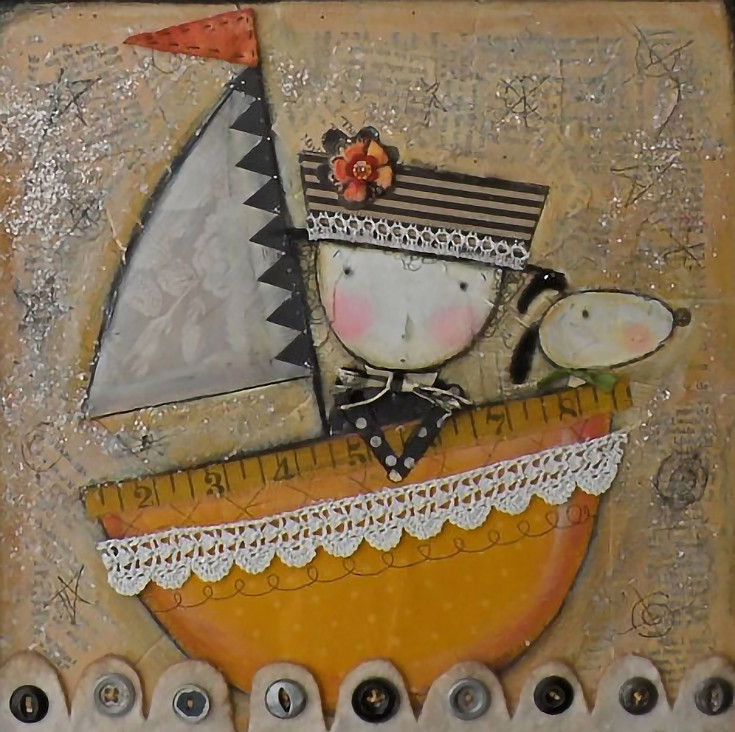
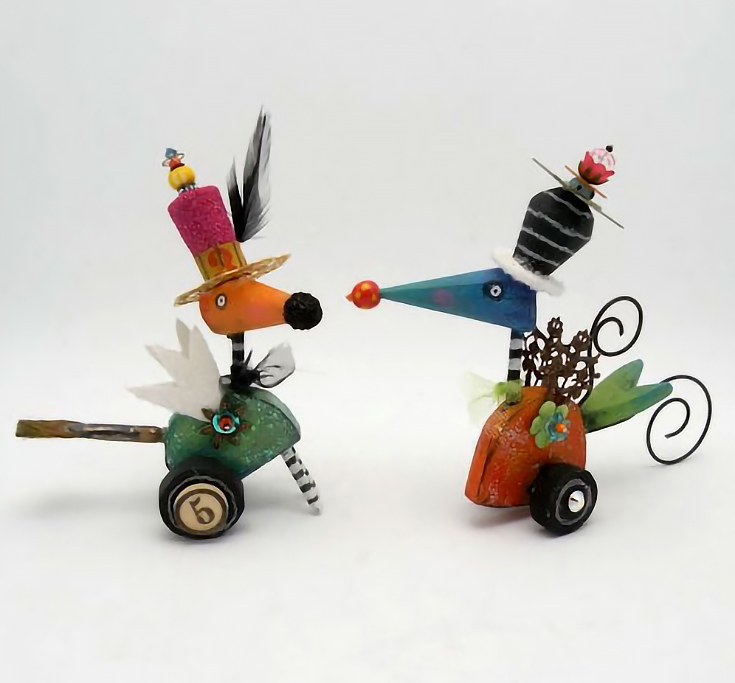
Julie: Whimsical art—art that makes me feel alive and happy. I mainly work with illustrations and watercolor, but for the past three years I have explored mixed media art using my fine art craft skills and love of folk art.
Alyice: What has been your greatest success as an artist?
Julie: I would have to say being able to support myself as an artist. But success can only come when you set goals and meet them—no matter how big or small, so you could say that has contributed to my success as an artist.
Alyice: Aside from selling your art, you hold several art workshops throughout the year. How did you get into teaching others about art?
Julie: When I worked for Hallmark Cards part of my job was to help train newly hired artists in the “Hallmark style.” Hallmark Cards has a precise look that they adhere to and most artists train from 2 to 5 years under an artist who has been there longer. During my stint training other artists, I discovered that I was good at it and that I truly enjoyed it.
But it was when I joined Hallmark’s program to help inner-city, underprivileged teens that I knew I was meant to teach. I loved how much these kids were into art and how they absorbed every bit of the whole experience. I fell in love with seeing the light shine in their eyes as they discovered a passion to create.
So when I decided to include mixed media art in my portfolio, it was a given that part of my new business would be to offer something others could learn as well.
Alyice: What do you like best about sharing your art techniques?
Julie: Knowing that for the time my students are in my class, we can forget the cares of the world. We can forget about life’s stresses, we can set aside our concerns and just immerse ourselves in the healing power of art.
Alyice: Aside from teaching art, you still learn from other artists. In your opinion, what makes a good art instructor?
Julie: A teacher who encourages her students and teaches them to build upon the lessons they’ve learned in her class, as well as in life. It is a teacher who sees the good working in everyone’s art—no matter what the skill level is. Because what makes art work, what makes art therapeutic, is the part that the artist most wants to express and it is the job of the art teacher to help the artist learn how to use art to express themselves and feel confident about what they have created.
Alyice: I’ve noticed that some workshops require artists to bring their own supplies, while others include supplies for an extra fee. In your workshops, all materials and tools are supplied; is there a benefit to having everyone use the same materials and how does providing materials work out for both you and your students?
Julie: The reason I try to include most of the supplies is because it can be rather costly for traveling guests to bring their own supplies, not to mention hard to drag along. Most of my workshops are “true” mixed media pieces, meaning many different materials are required and if you are forced to buy a lot of expensive tools, along with supplies, and find that there was only one material or technique you enjoyed, it can be quite frustrating.
Also, some of my workshops allow walk-ins, and I love to be able to accommodate them by having materials and supplies on hand.
Alyice: Having your own stash of art supplies and tools for every student, at every workshop, can get pretty expensive. How do you figure in the cost?
Julie: I am still working on that. To cut costs, I spend a lot of time hunting down discount prices and I buy in bulk when a bigger discount is given. I also don’t mind buying used items. For instance, yesterday I hit the thrift stores and found large food warmers that my students can use to dry paper clay items. Finally, I do a lot of online shopping and shopping at sales events.
I work hard not to be skimpy on supplies. That is a big “no no” to me as an instructor. Generous with the supplies means generous with the heart!!
As to the extra kit cost, some classes I teach use expensive materials like pewter, metal findings, paper clay, golden paint products, etc. So I am forced to charge a kit fee as I would lose money if I did not—and a loss would mean no more teaching.
If you’d like to learn more about Julie’s workshops or artwork, stop by her site at www.juliehaymaker.com

This post may contain affiliate links.