
Eugene Delacroix was a famous French Romantic painter born in 1798 near Paris. His paintings were first known for their classical excellence, and then for the movement and color he began to infuse into his works.
Some of Delacroix’s art was truly a mix, showcasing elements that can be found in Renaissance paintings as well as brushwork and emotion that seems much more modern.
Take for example this painting, titled Orphan Girl in a Cemetery.
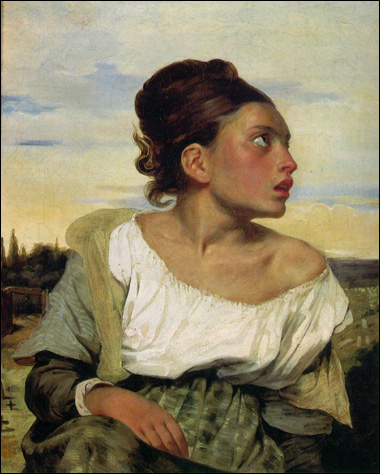
Certain features like the contrived curls of hair, the compacted, almost muscular neck, and the plump hand seem “lifted” from the classical works of one famous artist or another.
The neck appears as though Michelangelo painted it, and the hand is Mona Lisa’s, or perhaps one of Raphael’s madonnas.
But the face—the face is Delacroix’s, with a flush of lifelike color and poignant emotion.
You can see how some of his classicism began to fade away by the time Delacroix traveled to northern Africa in the 1830s. His paintings become looser with more movement, although his compositions were still very balanced.
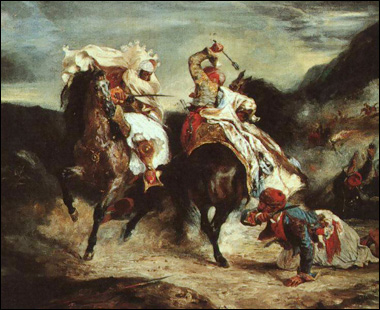
Battles and carnage soon became Delacroix’s specialty. I have a hunch that he liked the way he could emphasize each person’s emotions, through every line of their body.
Here, a stampeding crowd makes for a perfect Delacroix scene.
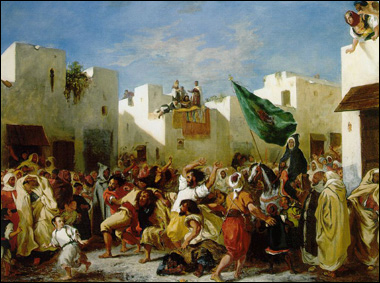
And Delacroix began to change things up even more to achieve his artistic goals.
Take a look at this next close-up of one of his paintings. In order to fully show the impressive line of charging horsemen, Delacroix pulled back the front horse’s head at an impossible angle.
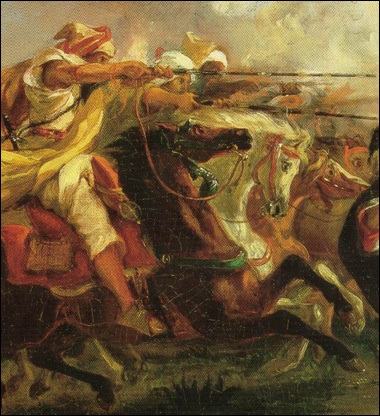
With feet far forward, and loose reigns, there’s no reason for such an unnatural pose, other than to emphasize and heighten the emotion of the situation for viewers.
It works too, creating a wall of horses and flying hooves that feel like they would trample you in an instant if you were foolish enough to step in front of them.
Delacroix’s of use of emotion rather than reality in his art was truly different, and it helped influence an entire generation of Romantic painters as well as set the stage for Impressionism.
Unfortunately, Delacroix barely lived to see the beginning of that famous movement. He died in 1863 at the age of 65.

This post may contain affiliate links.